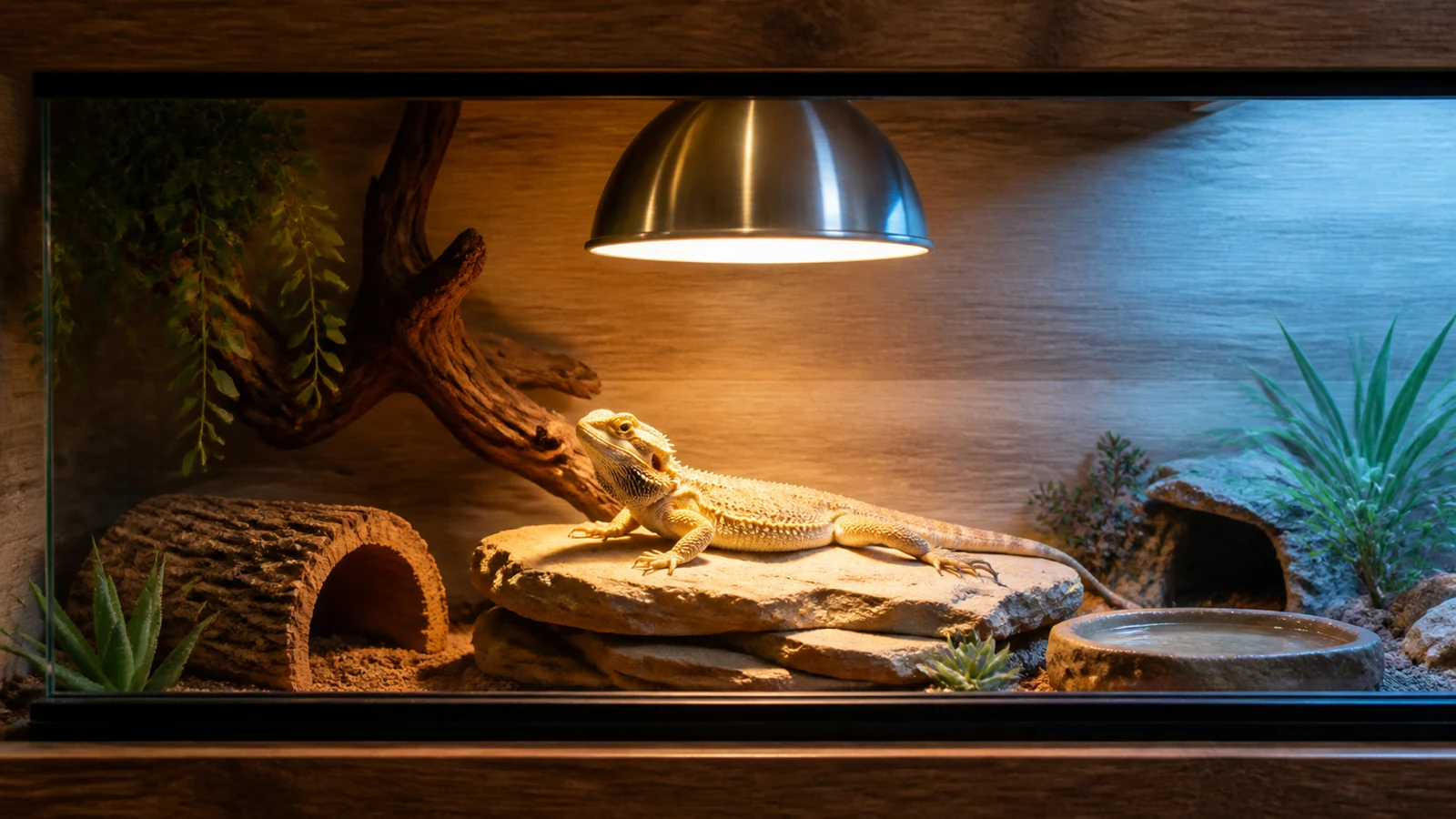
Bearded Dragon Basking Lamp Fixture Setup Uk
Direct answer: put the basking fixture overhead on the warm side, let the enclosure run long enough to stabilise, then measure the basking surface and cool side before changing wattage or distance. Guessing by bulb wattage alone is the common beginner mistake.
A first bearded dragon setup is really a gradient setup. The dragon needs access to a warm basking area and a cooler retreat, so the lamp fixture must create a usable difference rather than heat the whole vivarium evenly.
Beginner setup sequence
- Choose the warm side and place the basking rock or platform under the intended fixture position.
- Mount the dome securely above the basking area, respecting the enclosure roof, mesh and fixture instructions.
- Use a suitable basking bulb and a heat-appropriate holder.
- Run the lamp for a full warm-up period before judging the result.
- Measure the basking surface and cool side, then adjust distance, wattage or control method.
- Only add complexity after the basic warm-side and cool-side pattern makes sense.
Why the warm side should be overhead
Overhead placement mimics a simple basking pattern: light and heat come from above, and the animal can move in and out of the warm zone. UK heat-lamp guidance such as this reptile heat lamp guide stresses matching the heat source to the species and measuring both basking and cool areas.
A deep dome can help push the lamp output downwards and reduce side glare. UK product copy for a polished deep reflecting dome describes that focused basking-zone role, which is the reason many keepers choose a dome rather than a shallow open shade.
Measure after warm-up, not after ten seconds
Let the setup run before judging it. Wood, slate, mesh and air all warm at different speeds, and the temperature you see immediately after switching on is not the stable enclosure pattern. Bearded dragon setup guidance such as this basking light guide commonly pairs ceramic-socket domes with infrared thermometer checks after warm-up.
If the basking surface is too cool, do not automatically buy the highest-wattage bulb. First check fixture distance, reflector depth, room temperature and whether the cool side remains genuinely cool. If the cool side is also warming too much, the problem is not simply "more heat".
Day and night routine
For a basic daytime routine, bright basking heat belongs in the day period. Avoid relying on bright heat overnight. If the room drops too far at night, that becomes a separate non-light heat and thermostat question, not a reason to leave a basking bulb glaring all night.
Who this simple guide is not for
If you already run a calibrated multi-fixture vivarium with separate UVB, basking heat, probes and seasonal settings, you probably need a fine-tuning review rather than a beginner sequence. This guide is for the first setup where the next useful step is placement, warm-up and measurement.
Proceed or pause?
Proceed when the dome is secure, the bulb and holder match, and you can measure the surface after warm-up. Pause when you cannot measure temperatures, the fixture is unstable, or the setup heats both sides of the vivarium without giving the dragon a real choice.