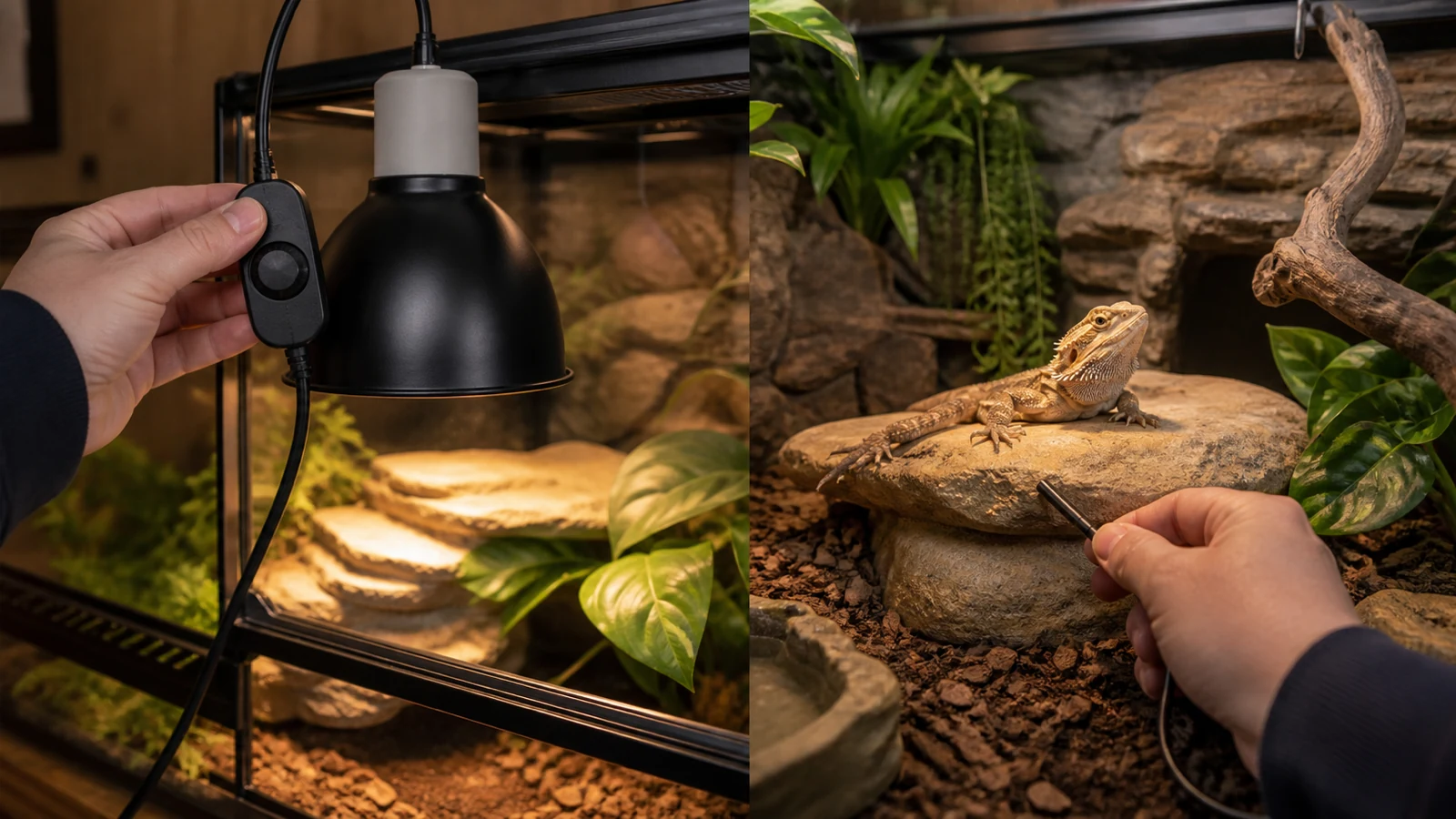
Reptile Lamp Dimmer Switch Vs Thermostat Uk
Direct answer: a dimmer switch changes how much power reaches a lamp, while a thermostat reacts to temperature. A dimmer can be useful for fine adjustment, but it does not know whether the vivarium is too hot or too cold. For unattended heat, ceramic heat emitters, night heat or rooms that swing with UK seasons, temperature feedback is the part that matters.
This distinction is easy to miss because both devices can make a lamp appear "controlled". The animal does not experience the switch; it experiences the surface temperature, air temperature and gradient inside the enclosure.
The practical difference
| Control | What it does | What it cannot do | Best use |
|---|---|---|---|
| Fixture dimmer | Lets you manually reduce or increase lamp output. | Cannot sense a warm room, cold night or blocked airflow. | Convenience adjustment for a light-emitting basking bulb after temperatures have been measured. |
| Dimming thermostat | Adjusts output in response to probe temperature. | Cannot fix a poorly placed probe or wrong bulb choice. | Light-emitting basking lamps where smooth control is appropriate. |
| Pulse or on/off thermostat | Cycles a heat source based on measured temperature. | May be unsuitable for visible bulbs if it causes flashing. | Non-light heat sources when matched to the equipment instructions. |
Why UK homes make fixed settings drift
A dimmer setting that works in September may run cooler in a draughty January room and hotter in a south-facing summer room. UK thermostat guides separate control types by heater type; for example, The Reptile Centre thermostat guide describes on/off, pulse proportional and dimming thermostats as different tools rather than interchangeable accessories.
That is the core mental model: a dimmer is a setting, a thermostat is a response. When the room changes, a fixed setting stays fixed.
Match the control to the heat source
Light-emitting basking bulbs are usually paired with dimming control when automated temperature control is needed, because abrupt on/off cycling can be visible and stressful. Non-light heat sources such as ceramic heat emitters are commonly discussed with pulse or on/off control depending on the product and setup. UK care guidance such as Serpentia Pet Supplies thermostat advice frames this as a heater-type matching decision.
Always read the thermostat and lamp instructions together. A socket, thermostat and bulb can each be individually good products and still be the wrong combination.
When a dimmer is enough
A dimmer can be enough as a convenience control when all of these are true: the heat source is a daytime visible basking lamp, the room is stable, you measure basking and cool-side temperatures after adjustment, and the lamp is not relied on for unattended night heat. In that situation the dimmer helps you land on a sensible output instead of swapping bulbs repeatedly.
When a thermostat is non-negotiable
Use proper temperature control when the heat source runs while nobody is watching, when using a ceramic heat emitter for night warmth, when the animal cannot easily escape the hot zone, or when the room changes a lot through the year. A public keeper explainer makes the key point plainly: a dimmer switch is not the same thing as a thermostat because it does not respond to temperature.
Can you use both?
Often, yes, if the equipment instructions allow it. A fixture switch can be treated as the local on/off or setup convenience, while the separate thermostat controls temperature. Do not place a manual dimmer in a way that prevents the thermostat from doing its job, and do not hide the probe where it measures the wrong part of the enclosure.
Decision point
If you only need a neater daytime adjustment after measuring temperatures, a dimmer-equipped fixture can be useful. If you need safety feedback, night heat, ceramic heat emitter control or seasonal stability, solve the thermostat question first and treat the fixture switch as secondary.